I’ve done a fair few “adventurous” things on this blog, but nothing came close to wrecking me the way the ATM Cave did. This wasn’t a nice add-on to a Belize trip. This was, hands down, the hardest physical thing I have ever put my body through and I say that as someone who went in without any special training, just a decent pair of trainers and a lot of nerves.
If you’re reading this because you’re planning a Belize trip and keep seeing “ATM Cave” pop up on every must-do list, good. This post is for you. I’ll walk you through exactly what happened when I went in November 2025, plus everything you need to know before you book like the history, the rules, what to pack, what it actually costs, and whether you should do it.
Short answer: yes. Do it. But go in with your eyes open.
What is the ATM Cave, actually?
ATM stands for Actun Tunichil Muknal, which translates to “Cave of the Crystal Sepulchre.” It’s tucked inside the Tapir Mountain Nature Reserve in the Cayo District of western Belize, not far from the town of San Ignacio.
To the ancient Maya, this wasn’t just a cave. It was believed to be an entrance to Xibalba, the underworld, where the gods of rain, agriculture, and fertility lived. Between roughly 300 and 900 AD, Maya priests carried offerings deep into the cave like pottery, tools, and eventually, during periods of drought and scarcity, human lives. Archaeologists have found the remains of at least 14 people inside, including several children, along with pots deliberately marked with “kill holes” believed to have been part of the ritual.
The cave was forgotten for over a thousand years until it was rediscovered in 1989 and studied by Belizean archaeologists through the 1990s. It only opened to the public in 1998, and access has been tightly controlled ever since. Only a small number of licensed guides are permitted to lead tours inside so you cannot visit this cave on your own, full stop, and you shouldn’t want to. This place deserves that level of protection.
Since 2012, cameras and phones have been completely banned past a certain point in the cave. This came after a tourist dropped a camera and cracked a skull that had survived undisturbed for over a thousand years. So no, you won’t get the photo. You’ll get the memory, which honestly ends up meaning more.
My experience: November 2025
We were part of the first batch to go in that day, which felt oddly fitting given where we were about to end up. Our guide met us early, ran through the safety briefing, and made it very clear: no phones, no cameras, nothing that isn’t strapped to you or in a dry bag. Every group of 2 to 4 people gets one guide that’s the ratio, no exceptions, and once you’re inside you understand exactly why.
The hike in
It started off deceivingly easy. A muddy jungle trail, birds going off somewhere overhead, that thick warm Belize air. Nice, gentle, the kind of walk you do half-listening to your guide’s stories.
Then came the rivers. Plural 😮💨. We crossed several of them, and the water level changed constantly, from ankle-deep to properly high, depending on where the tide sat that day. This part alone took about an hour and a half. By the time we reached the cave entrance, my shoes were soaked through, my legs were tired, and I hadn’t even seen the cave yet.
Gearing up
Near the entrance, we stopped to rest, ate a few snacks, and had some water the last proper break before going in, because once you’re inside the cave you don’t eat or drink again until you’re back out. We left our bags near the cave. From here it was just a life jacket, a helmet with a torch mounted on it, and whatever was already on our bodies.
Into the cave
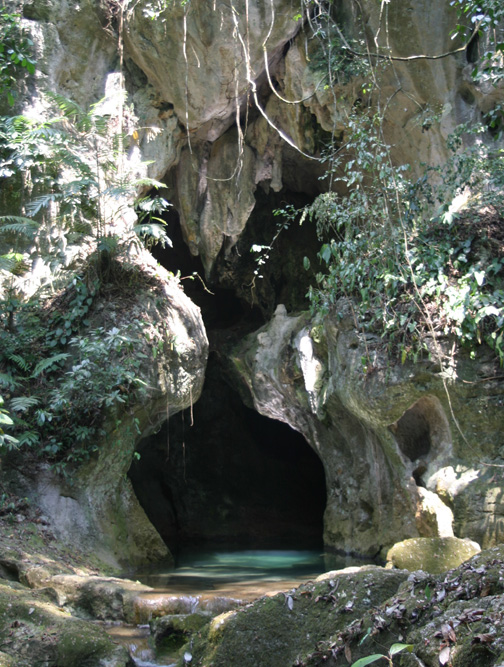
The entrance to ATM is a huge pool of water, and to get inside you swim into the cave mouth itself. This is where it stopped being a nice jungle walk and started being genuinely hard. You have to swim against the current, into the dark, and I will fully admit I underestimated this. At one point I was properly stuck and my guide had to physically push me forward to get me through. Not glamorous. Very real.
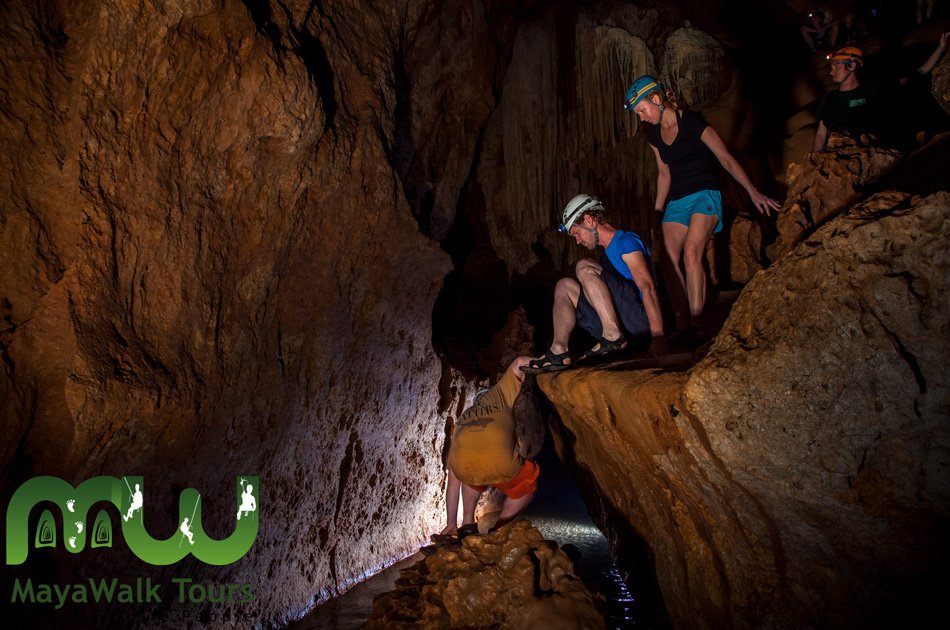
Once inside, we waded and swam further in, through passages that got narrower and narrower. At one point the space between the rocks was so tight, with water filling the gap, that the only way through was to duck under, swim a few strokes, and come up on the other side into an equally cramped space. This was the point where I was, in my head, completely losing it. Dark water, tight rock, torch light bouncing everywhere, and no way to see how far the gap actually went until you were committed to it. I did it anyway. You do it because the guide is right there, calm as anything, and because turning back isn’t really an option at that point.
The Cathedral
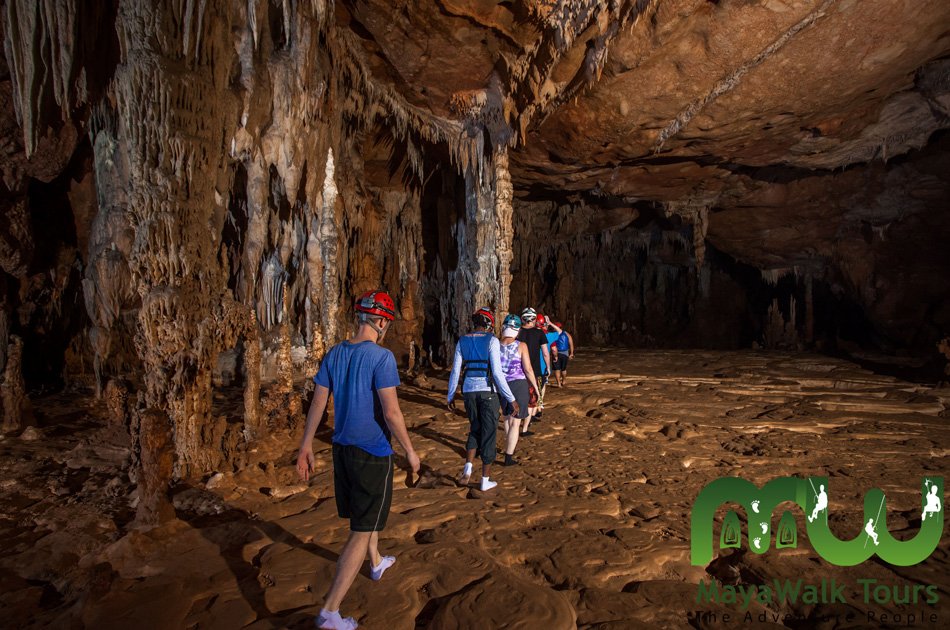
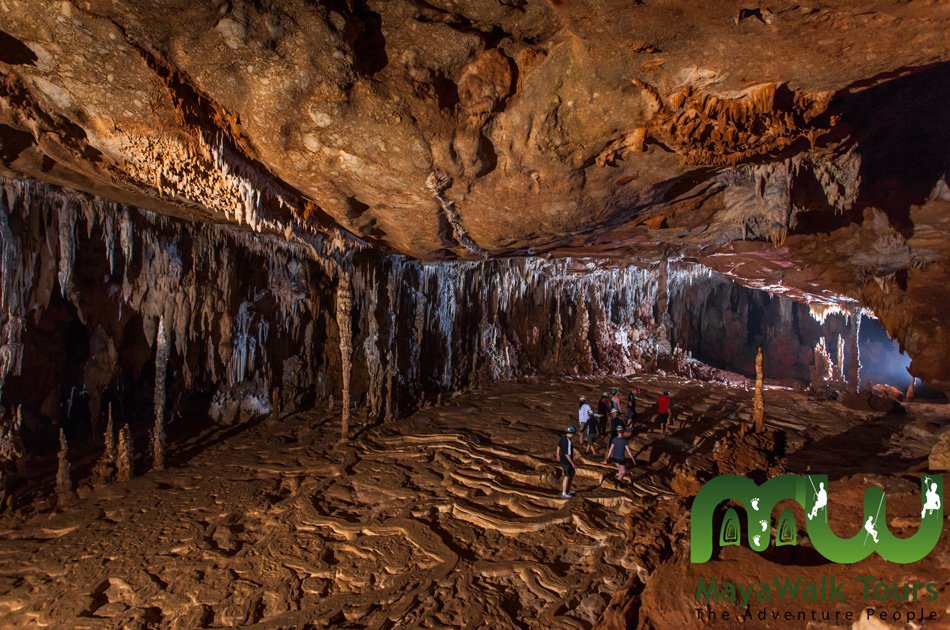
Then, almost without warning, the cave opens up into this enormous chamber. The water level drops, your torch beam actually has room to travel, and you can see stalactites and stalagmites and these strange, beautiful natural formations that took thousands of years to grow. After the cramped swim just before it, this part felt like being let out of a fist. It’s genuinely one of the most beautiful natural spaces I’ve ever stood in, and I mean that as someone whose torch was the only light source for hundreds of metres in every direction.
Barefoot to the Maya site
From there, we climbed up a section of very slippery rock to reach the upper chamber, and this is where the rules get strict: shoes off. From this point on, you’re barefoot or in socks only, no exceptions, because the ground itself is part of the archaeological site and untreated skin and socks do far less damage to the delicate cave floor and any surviving material than tread on a shoe.
At the top, you’re standing in what was once a Maya ceremonial and sacrificial site, and it does not look like a museum. It looks exactly like what it is: a room that people walked out of over a thousand years ago and nobody ever came back to tidy up. Pottery lies scattered across the ground precisely where it was left, some of it broken deliberately by the Maya as part of the ritual, some of it still whole. Our guide pointed out a few pieces with small punched-out holes in the sides, known as “kill holes,” believed to have been made so the spirit inside the vessel could be released once its ceremonial use was done.
The why of it all is grim but fascinating. Archaeologists believe much of the activity in this part of the cave dates to a period of severe drought and crop failure, somewhere around 800 to 900 AD, when the Maya turned to increasingly desperate offerings to try to appease the rain gods. Caves like this one were seen as portals straight down into Xibalba, the underworld, so what better place to plead your case than at the door itself.
Then you reach the remains. There are several skeletons scattered through this upper section, including children, which our guide explained without dressing it up: children were considered pure, and purity was exactly what the gods were thought to want in an offering. It’s a hard thing to stand next to, genuinely, and there’s no version of seeing it that doesn’t sit with you for a while afterwards.
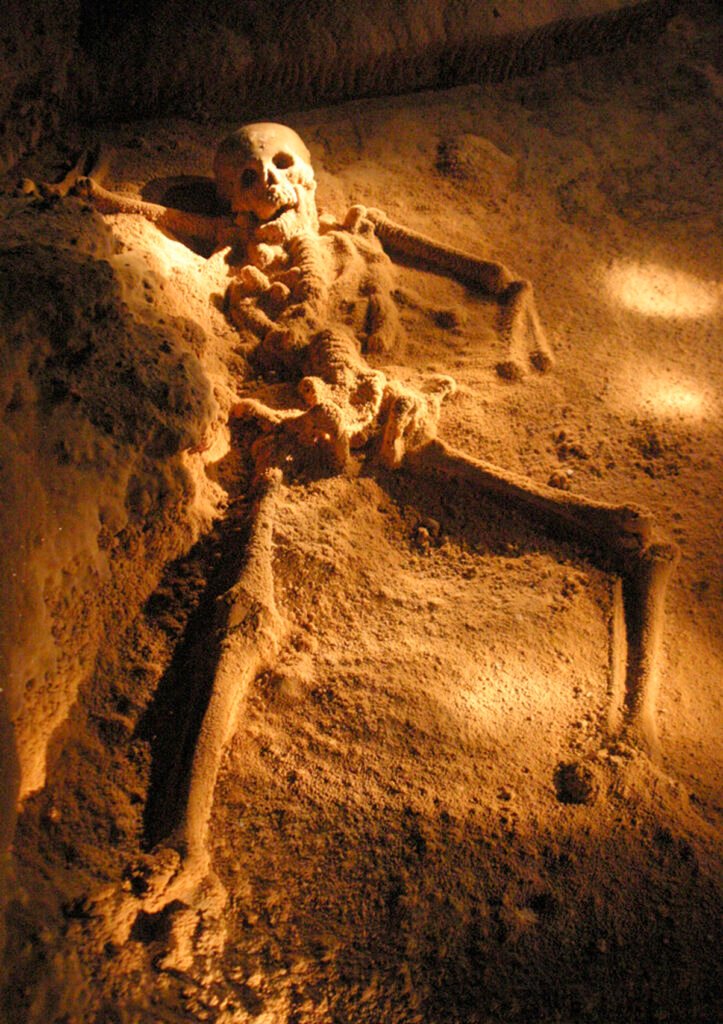
The one everyone comes for, though, is the Crystal Maiden. It’s a full skeleton, almost entirely intact, lying on the cave floor in its own small chamber near the end of the route. Over the centuries, calcite from the water dripping through the limestone has slowly coated the bones, and when your torchlight hits them they genuinely sparkle. It’s an incredible, eerie effect, and it’s the reason the name has stuck even though researchers now think the remains may actually belong to a young man rather than a woman. Whoever it was, the skull shows signs of a hard blow, which is part of why this is believed to be a sacrifice rather than a natural death or a normal burial.
Nothing here is roped off. Nothing is behind glass. You are standing an arm’s length from pottery, bone, and ritual objects that predate almost anything we’d call “old” anywhere else in the world, in the exact spot they were left, and it is deeply humbling in a way that’s hard to describe until you’re actually standing there in wet socks with a torch on your head.
The way back
Then you do the entire thing in reverse. Same narrow gaps, same swim against water, same river crossings, back out into daylight and back to your bag on the bank. By the time we finished, I had bruises up and down my arms and legs, a couple of proper scrapes, and absolutely no regrets. What an experience.
Is the ATM Cave tour hard? Let’s be honest about it
Every tour operator will tell you “moderate fitness required.” I went in without being especially active, and I pushed through it, but I won’t sugarcoat it: this is physically demanding. You need to be able to swim, comfortably, in open water and in the dark. You need decent grip strength and balance for the rock scrambling. You need to genuinely be okay with tight, dark, wet spaces, because there is a stretch in there where you cannot see daylight, cannot see your group clearly, and cannot turn back easily.
If you have serious claustrophobia, a fear of swimming, or existing joint or mobility issues, have an honest conversation with the tour operator before booking. This isn’t a tour you can tap out of halfway through once you’re in the middle chambers, going forward is usually easier than going back.
What you need to know before booking
You can only visit with a licensed guide. The Belizean government keeps a tight cap on who is allowed to lead tours inside ATM, specifically to protect the site. This is a good thing. Book through a recognised tour operator, not a random guy offering you a “cheaper deal” on the street in San Ignacio.
No phones, no cameras, no GoPros. This has been the rule since 2012. Leave anything electronic in the car or your bag at the entrance. There is no way around this, and honestly, after doing the tour, I understand completely why it’s enforced.
Guide ratio is capped. In our group it was one guide per 2-4 people. This isn’t a “the more the merrier” kind of tour, and that’s exactly what makes it feel safe even in the tightest parts of the cave.
Bring:
- Closed-toe shoes you don’t mind getting soaked (old trainers, not flip-flops or sandals)
- A swimsuit or quick-dry clothes underneath
- A dry bag if you’re bringing anything valuable to leave at the entrance (car keys, cash, ID)
- A change of clothes for after
- Cash for snacks/water before entry and for tipping your guide
You’ll be given: a helmet with an attached torch and a life jacket for the swim sections. Some operators also provide socks for the barefoot section, but bringing your own thick pair isn’t a bad idea.
What it costs: I booked through Belize Caving Expeditions and paid around $140 USD per person, which included transport, the guide, entry fees, gear, and lunch. Prices vary a bit by operator and season, so treat this as a ballpark.
Best time to go: The tour runs most of the year, but river levels rise significantly in the rainy season (roughly June through November), and the cave can close entirely after heavy rain when the entrance pool becomes unsafe to swim into. If your trip dates are flexible, drier months (February to May) give you the most predictable conditions. I went in November and had multiple river crossings that ranged from low to fairly high, so plan for wet, changeable conditions regardless of season.
How long it takes: Budget the better part of a day. Between the drive from San Ignacio, the jungle hike and river crossings, roughly three hours inside the cave, and the return trip, you’re looking at around 8-10 hours door to door.
Should you do it?
If you want a genuinely comfortable, dry, camera-friendly day out then this isn’t that. But if you want to feel, physically and completely, what it means to stand inside a sacred Maya site exactly as it was left over a thousand years ago, with nothing but a torch and your own two feet getting you there, this is one of the most rewarding things you can do in Belize.
I went in nervous, underprepared in terms of fitness, and came out with bruises, a few scrapes, and one of the best stories I’ve ever gotten to tell. Do it once. You’ll never forget it.
Have you done the ATM Cave tour, or are you planning your own Belize trip? Drop a comment below I’d love to hear about it, or answer any questions before you go.